Book: “Persepolis: The Story of a Childhood”

Persepolis: The Story of a Childhood

Marjane SatrapiMattias Ripa (Translator)

In powerful black-and-white comic strip images, Satrapi tells the story of her life in Tehran from ages six to fourteen, years that saw the overthrow of the Shah’s regime, the triumph of the Islamic Revolution, and the devastating effects of war with Iraq. The intelligent and outspoken only child of committed Marxists and the great-granddaughter of one of Iran’s last emperors, Marjane bears witness to a childhood uniquely entwined with the history of her country.

Persepolis paints an unforgettable portrait of daily life in Iran and of the bewildering contradictions between home life and public life. Marjane’s child’s-eye view of dethroned emperors, state-sanctioned whippings, and heroes of the revolution allows us to learn as she does the history of this fascinating country and of her own extraordinary family. Intensely personal, profoundly political, and wholly original, Persepolis is at once a story of growing up and a reminder of the human cost of war and political repression. It shows how we carry on, with laughter and tears, in the face of absurdity. And, finally, it introduces us to an irresistible little girl with whom we cannot help but fall in love.

About the author

Marjane Satrapi

Marjane Satrapi (Persian: مرجان ساتراپی) was born in Rasht (Iran, 22nd November 1969 – Paris, june 4th, 2026). Conditioned by the extremism of the 1979 Revolution, her parents sent her to Vienna in 1983 to finish her studies at the French Lyceum in the Austrian capital. She later returned to Tehran and enrolled in the School of Fine Arts, but, in 1994, she moved to France before graduating. She studied at the School of Decorative Arts in Strasbourg (currently, Haute école des arts du Rhin) and later moved to Paris. According to specialists, Marjane Satrapi is one of the most prominent names in international comics, author of what is, for many, one of the best graphic novels ever published: Persepolis (2000), an autobiographical story that narrates her childhood and adolescence in Iran, of which it has been said that “few works have had such an ability to permeate pop culture and, at the same time, be one of the best historical narratives of our time”. Persepolis won the Angoulême Coup de Coeur Award for Best New Author at the Angoulême Festival. In 2001, the second volume also received the award for Best Script at Angoulême. The third and fourth volumes achieved even greater popularity, garnering international success. In 2007, she teamed up with Vincent Paronnaud to turn the comic into an animated film. The adaptation won the Film Critics Grand Prix at the Cannes Festival in 2007 and the César Award for Best Adapted Screenplay in 2008, in addition to being nominated for Best Animated Feature at the 2008 Oscars. Other notable works of hers include Broderies (2003) (Embroideries, 2005) and Poulet aux prunes (2004) (Chicken with Plums, 2006), which was also adapted to film in 2011. In 2023, she coordinated the book Femme, vie, liberté (Woman, Life, Freedom, 2024) together with political scientist Farid Vahid and historian Abbas Milani, both Iranians, and French reporter Jean-Pierre Perrin, in addition to an international group of seventeen comic book authors (including Spaniards Patricia Bolaños and Paco Roca and several Iranians). In this work, she illustrates the revolts that occurred in Iran after the murder of Mahsa Amini in 2022 at the hands of the so-called “morality police”, and denounces the repression and lack of human rights that, according to Satrapi, Iranian society, especially women, suffer at the hands of the regime. The Persian version of this book is accessible online for free to all Iranians.

In addition to the film adaptation of Persepolis, Satrapi has directed the films La Bande des Jotas (The Gang of Jotas, 2012), The Voices (2014) and Radioactive (2019), a biography of scientist Marie Curie. Another discipline in which she has stood out has been painting, with important exhibitions in Parisian galleries such as the Galerie Jérôme de Noirmont. This year, a tapestry designed by Satrapi commissioned by France’s statutory Mobilier Nacional is on display at the Hôtel de la Marine in Paris to mark the upcoming Olympic Games in Paris. Commander of France’s Order of Arts and Letters, Marjane Satrapi holds honorary degrees from the Belgian universities UC Louvain and KU Leuven. She was elected member of the French Academy of Fine Arts in 2024.

(Goodreads.com)

The Civil War | Full Episode 1 | 1861: “The Cause” | PBS

Ken Burns Jun 1, 2026 Watch more with Passport: https://to.pbs.org/3SwZLNS Beginning with a searing indictment of slavery, this first episode dramatically evokes the causes of the war, from the Cotton Kingdom of the South to the northern abolitionists who opposed it. Here are the burning questions of Union and states’ rights, John Brown at Harpers Ferry, the election of Abraham Lincoln in 1860, the firing on Fort Sumter, and the jubilant rush to arms on both sides. 1861: “The Cause” | The Civil War This program is made possible by viewers like you. Support your local PBS station: https://www.pbs.org/donate Enjoy full episodes of your favorite PBS shows anytime, anywhere with the free PBS app: https://to.pbs.org/2QbtzhR

Weekly Translation: People with lots of money are arrogant and abusive.  I don’t want to be arrogant and abusive, therefore I don’t want lots of money.

By Mike Zonta, BB editor

Translation is a 5-step process of “straight thinking in the abstract” comparing and contrasting what seems to be truth with what you can syllogistically, axiomatically and mathematically (using word equations) prove is the truth. It is not an effort to change, alter or heal anything other than our consciousness.

The claims in a Translation should be outrageous and mind-blowing, but they are always (or should always be) based on self-evident syllogistic reasoning. Here is my Translation from this week. 

1)    Truth is that which is so.  That which is not truth is not so.  Therefore truth is all that is. Truth being all is therefore total, therefore whole, therefore one, therefore at one, therefore in agreement, therefore at peace, therefore Self-entangled.  I think therefore I am. Since I am and since Truth is all that is, I cannot be outside of all that is, therefore I, being, am Truth.  Since I, being, am Truth, therefore I, being have all the attributes of Truth.  Therefore I , being, am total, whole, one, at one, in agreement, at peace, Self-entangled.  Since there can be no being without awareness of it, therefore Truth is awareness/consciousness.

2)    People with lots of money are arrogant and abusive.  I don’t want to be arrogant and abusive, therefore I don’t want lots of money.

Word-tracking:
people:  mortal
money:  worth, power, ability to do, mental
worth:  merit, what one deserves, reward
reward:  to value others, measure how one is worth
arrogant:  to claim, to assume, to arrogate, to adopt an adult as a son
value: to be well, to be strong
abusive:  to misuse, use up, consume. 

3)    Truth being all is therefore without limit, therefore immortal.  Truth being immortal, people (mortals) are a lie about the immortality of personhood OR Personhood is immortal. Truth being all that is cannot be consumed since there is nothing other than Truth to consume.  Therefore Truth cannot be used up, misused, abused.  Truth being all that is is therefore of infinite value/worth. Truth being of infinite value/worth, there is no arrogance or claiming more than one is worth.  Therefore Truth rightfully arrogates to Itself infinite worth.  Truth being all that is, there can be no power other than Truth, therefore Truth is limitless power.  Truth being limitless power is therefore limitless ability to do, limitless value, limitless worth, limitless strength, limitless wellness, limitless merit.  

4)    Truth is immortal.
        Personhood is immortal. 
        Truth cannot be used up, misused, abused.
        Truth is of infinite value/worth.
        Truth rightfully arrogates to Itself infinite worth.
        Truth is limitless power. 
        Truth is limitless ability to do, limitless value, limitless worth, limitless strength, limitless wellness, limitless merit.  

5)    The Personhood of Truth rightfully arrogates to Itself limitless power, limitless ability to do, limitless value, limitless worth, limitless strength, limitless wellness, limitless merit.  

For information about Translation or other Prosperos classes go to: https://www.theprosperos.org/teaching.

Or, if you have taken Translation class, join us each Saturday for Translation Saturday Meeting at 11 a.m. Pacific time for current, up-to-the-minute Translations on the issues of the day.  Email zonta1111@aol.com for the Zoom link.

Translation Saturday Meeting June 6

June 6:  11:00 AM – 12:00 PM PST

Mike Zonta, H.W., M.

In a crisis — any crisis — The Prosperos offers Translation.  Translation Saturday Meetings is a weekly series of Translation presentations by veteran Translators, live and up to date on the issues of the day.

It is not a Translation workshop,  It is not a Translation class.  It is not a group Translation in the usual sense, though group participation is encouraged.

It is, however, restricted to those who have taken Translation class. So if you have never taken Translation class, check the calendar tab on The Prosperos website (TheProsperos.org) or get in touch with us and we will schedule a class.

Last week our sense testimony was:  Thyroid node is a build up of stress due to self-imposed deadlines and helping others who can’t take care of themselves. And our conclusion was:   Truth is the only regulation, the only thyroid, being instantaneous, complete and fearless.

– – – – – – – – – – – – – – See you there!!! – – – – – – – – – – – – – –

Here’s the link:  https://us02web.zoom.us/j/81749347119

For more info and link to join please email Mike Zonta at:

zonta1111@aol.com

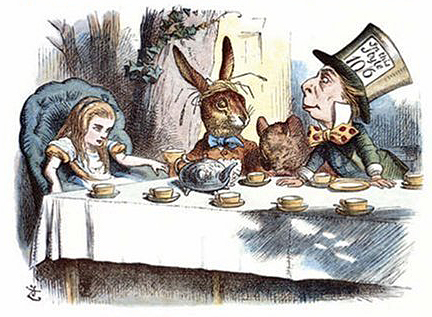
Word-built world: Alice in Wonderland

Alice’s mad tea party, 1865 Art: John Tenniel

A.Word.A.Daywith Anu Garg

Alice in Wonderland

PRONUNCIATION:

(AL-is in WUHN-duhr-land) 

MEANING:

noun: An absurd, illogical, or fantastical situation.
adjective: Absurd, dreamlike, fantastical, or illogical.

ETYMOLOGY:

After Alice’s Adventures in Wonderland (1865), a children’s novel by Lewis Carroll. Earliest documented use: 1874.

NOTES:

In Alice’s Adventures in Wonderland, Alice follows a rabbit down a rabbit hole into Wonderland, where she meets talking animals, vanishing cats, mad tea-partiers, murderous monarchs, and more.

When dealing with an Alice-in-Wonderland scenario, trying to apply logic will only make you mad as a hatter. Best to just embrace the absurdity before you lose your head over the details.

Another word coined after the book is Alician. Also see rabbit hole, a phrase Carroll did not coin literally, but one whose figurative life owes much to Alice’s tumble.

For words coined in the sequel, Through the Looking-Glass, see here. Also see micropsia, aka Alice in Wonderland syndrome.

Vajrayana Buddhism for Westerners with Andrew Holecek

New Thinking Allowed with Jeffrey Mishlove Jun 4, 2026 Andrew Holecek was trained for decades within the Tibetan Buddhist traditions of Dzogchen and Mahamudra, and having completed the traditional three-year retreat. He is the author of numerous influential books, including Dream Yoga, The Lucid Dreaming Workbook, Preparing to Die, Dreams of Light, and his newest work is Total Eclipse of the Mind: Unleashing the Power of Darkness for Creativity, Healing and Transformation. His website is https://www.andrewholecek.com/ Andrew explores Vajrayana Buddhism as a living transformational path for modern Westerners, drawing from decades of Tibetan Buddhist training, dream yoga, sleep yoga, and dark retreat practice. He discusses lucidity, the dreamlike nature of reality, the states of consciousness associated with waking, dreaming, dying, and deep sleep, and how these experiences can cultivate wisdom, compassion, and awakening. Holecek also examines emptiness, non-dual awareness, the bardos, lucid dreaming, and the integration of psychology, spirituality, and consciousness studies into everyday life. 00:00:00 Introduction 00:02:44 Andrew’s journey into Vajrayana Buddhism 00:06:42 Three-year retreat and meditative discipline 00:11:03 Consciousness, contraction, and openness 00:19:05 Dream yoga and spiritual practice in daily life 00:25:56 Lucid dreaming and the nature of reality 00:31:31 Sleep yoga and deep dreamless awareness 00:42:28 Dreamers, perception, and non-dual awareness 00:49:07 Bardos, death, and ritual phenomenology 01:02:10 Conclusion New Thinking Allowed host, Jeffrey Mishlove, PhD, is author of The Roots of Consciousness, Psi Development Systems, and The PK Man. Between 1986 and 2002 he hosted and co-produced the original Thinking Allowed public television series. He is the recipient of the only doctoral diploma in “parapsychology” ever awarded by an accredited university (University of California, Berkeley, 1980). He is also the Grand Prize winner of the 2021 Bigelow Institute essay competition regarding the best evidence for survival of human consciousness after permanent bodily death. He is Co-Director of Parapsychology Education at the California Institute for Human Science. (Recorded on May 18, 2026)

Book: “Warmth: Coming of Age at the End of Our World”

Warmth: Coming of Age at the End of Our World

Daniel Sherrell

From a millennial climate activist, an exploration of how young people live in the shadow of catastrophe

“Strikingly perceptive.” –Jenny Offill, author of Weather

“Beautifully rendered and bracingly honest.” –Jenny Odell, author of How to Do Nothing

Warmth is a new kind of book about climate change: not what it is or how we solve it, but how it feels to imagine a future–and a family–under its weight. In a fiercely personal account written from inside the climate movement, Sherrell lays bare how the crisis is transforming our relationships to time, to hope, and to each other. At once a memoir, a love letter, and an electric work of criticism, Warmth goes to the heart of the defining question of our time: how do we go on in a world that may not?

(Goodreads.com)

How to Hold Your Remorse: Maira Kalman’s Illustrated Meditation on Wresting Defiant Joy in Living from an Imperfect Life

By Maria Popova (themarginalian.org)

Each time we have tried to elevate ourselves above the other animals by claiming singular possession of some faculty, we have been humbled otherwise: Language, it turns out, is not ours alone, nor is the use of tools, nor is music. Elephants grieve, octopuses remember and predict, crows hold grudges.

Perhaps one day this too will be snatched from us, but for now there seems to be one tumult of being pulsating in the human breast alone: the capacity to be sorry, to feel the soul-ache of remorse as the penitent past fangs the flesh of the present.

How to hold our remorse, how to make of it a catalyst for creation, is what the philosopher-artist Maira Kalman explores in her small and splendid book Still Life with Remorse — a collection of miniature essays, poems, and painted vignettes reckoning with remorse through Maira’s own family story, punctuated by glimpses of the lives of some of her muses: Leo Tolstoy, Clara Schumann, Virginia Woolf, Franz Kafka, Henri Matisse.

Objects in Matisse’s Studio by Maira Kalman

Defining remorse as “deep regret implying shame, implying guilt, implying sorrow,” Maira observes that “in still lifes and interiors there must be a certain amount of remorse lurking among the bowls of fruit, vases or flowers and objects scattered about the room.”

Rising from the pages is the intimation that memory is the still life of living, that while remorse may haunt the mental images of our recollections, we can find in it an occasion for beauty, for creative vitality, for defiant joy.

Tolstoy Eating Breakfast by Maira Kalman

Opening with an allusion to that immortal line from Anna Karenina — “All happy families are alike; each unhappy family is unhappy in its own way.” — she considers the half-life of sorrow across generations:

Happy families,
Unhappy families.
All the same, right?
Ach. ach. ach.

To begin
You are born.
To a long line of ancestors
who are long gone
but still yell or whisper
in your ear
in the depths of night.
A game of telephone played
from one generation to the next.

Garbled and confused.
Glimmers of light.
Misunderstandings.
Errors.

And now, here you are.
With the ones you love.
Or the ones you don’t.

The ones you cannot live without.
The ones you would like to smite.

Those who have disappointed you
or betrayed you. Those who have
been kinder than you deserve. And
the kind ones who inevitably die.
And leave you feeling very much
alone. They are what you have.

And if you think, at any given point,
that you know what is going on,
you are sorely mistaken.

And yet.

With an eye to the complicated marriage of Sophia and Leo Tolstoy (so different from that of Anna and Fyodor Dostoyevsky) — the initial mutual infatuation, the thirteen children, the selflessness with which Sophia transcribed all of Leo’s writings, the mutual resentment of the end — she writes:

When trying to understand why human beings do what they do, a fog descends.

The verse to which Mahler wrote music becomes a quiet animating chorus for the book:

Dark is life.
Spring is here.
The birds are singing.

Virginia Woolf’s Writing Table by Maira Kalman

From the personal stories — her grandparents killed in the Holocaust, her father delivering milk as his cover while working for a Palestine liberation underground, Kafka’s troubled relationship with his own father, Clara Schumann’s tenacity and her tender unclassifiable relationship with Brahms — emerges a universal lens on suffering, remorse, and redemption, shining a sidewise gleam on what makes life worth living despite the almost unbearable brunt of being alive.

Your family.
My family.

Your remorse.
My remorse.

All the same, right?

Vast skies full of remorse.
Oceans of remorse.
But enough.

There should be merriment.
And good cheer.
Good tidings. Well wishing.

Tables laden with food.
Children playing.
Gathering of kinfolk.

Like Clara would have wanted.
Seeing the best.
Forgiving the worst.

If there is remorse,
let there be a limit to remorse.
A way to shake off the heavy weight.

But how can we make this happen?
How to do this?

Dark is life.
Spring is here.
The birds are singing.

In the strangeness of life, LIVE.

Yellow Vase by Maira Kalman

Couple with “Antilamentation” — poet Dorianne Laux’s antidote to regret — then revisit Maira Kalman’s wonderful Women Holding Things and her illustrated love letter to Alice B. Toklas and Gertrude Stein’s love.

Consciousness, spirituality, biography, sexuality, androgyny, futurism, space, the arts, science, astrology, democracy, humor, books, movies and more